Architecture of the Void: What Concrete Has Forgotten About Old Cities
In 1284 a sultan in Cairo began a hospital. Years before, Qalawun had fallen seriously ill in Syria and been cured with a prescription from the Nur al-Din hospital in Damascus, founded in 1154 and still standing as a museum of medicine. He swore to build one like it. The inscription over the entrance says the whole complex, hospital, school and tomb, went up in 13 months; the hospital was finished first. It ran on rent from endowed city property, a million dirhams a year by al-Maqrizi's estimate, most of it for the hospital. Inside, patients were placed by ailment, each of the four iwans had its waterspout, and people leaving were given money and clothing.
Now look at the gate. When the complex opened, a trough for animals stood there. The dung piled up, the smell offended people, and in 1326 the trustee moved the trough and put a sabil, a public drinking fountain, in its place. Twenty years later another amir added a sabil-kuttab: water for passers-by below, a school teaching orphans to read and write the Qur'an above.
That corner is the argument of this piece: a building funded, watered and corrected by how people used it.
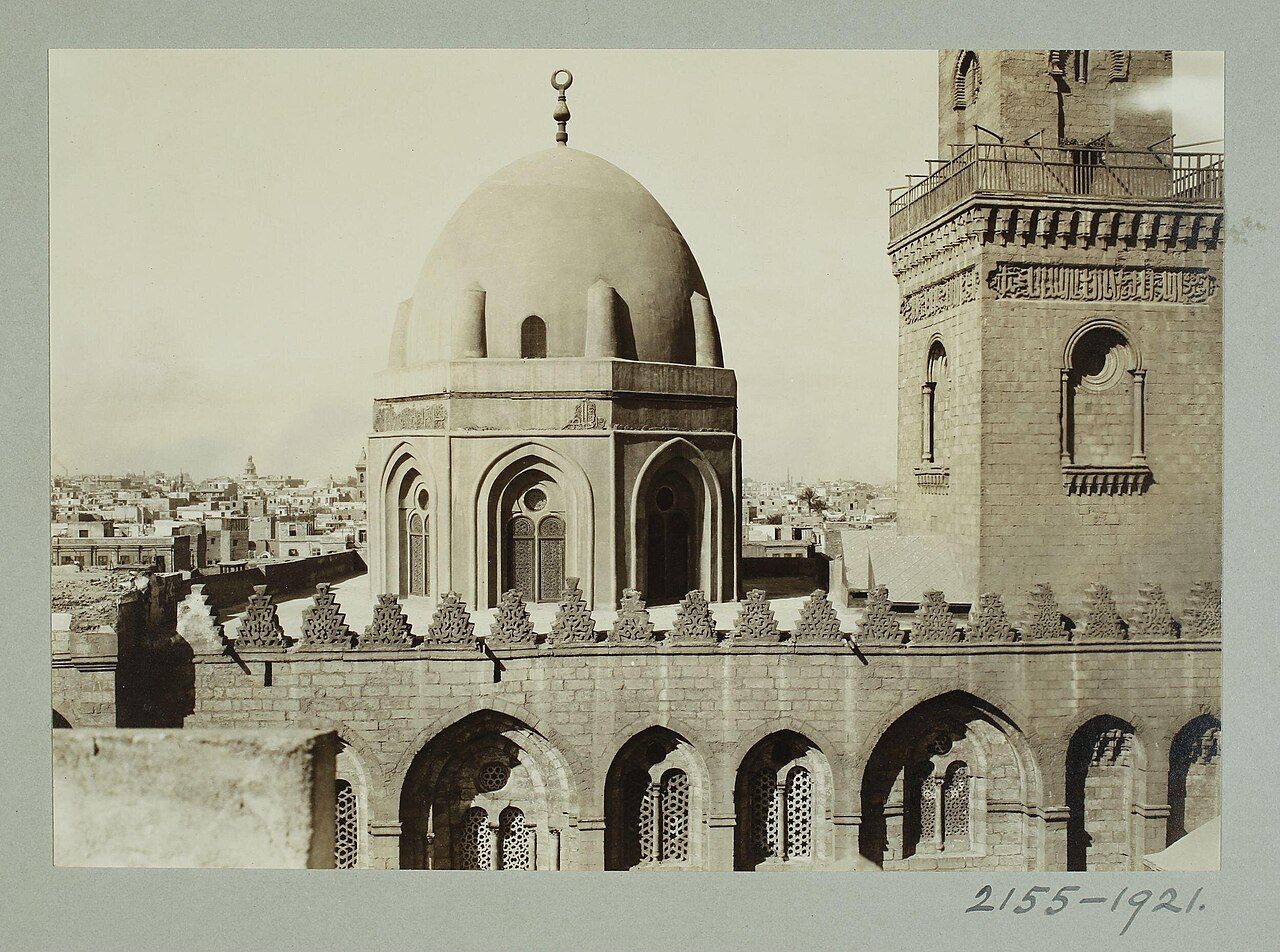
An early photograph of the dome, minaret and arcaded wall of the Qalawun complex in Cairo, with the city behind. K. A. C. Creswell, Public domain, .
Khaled Azab, formerly projects director at the Bibliotheca Alexandrina, has written several books on this, among them فقه العمران, subtitled الدولة والمجتمع والعمارة في حضارة المسلمين. I could not read it. What follows draws on an interview Azab gave in February 2023 about his books on العمران, and on Al Jazeera's review, that June, of المجتمع والعمران, published in Doha.
Azab's definition of علم العمران is plain: the science "that seeks to achieve human happiness in this worldly life". He follows Ibn Khaldun on where a city should stand, healthy air and water "on a river or beside fresh springs", and says the law of building extends into a law of water. Buildings, for him, are evidence: by studying what survives, "we can read the past and explain the movement of العمران".
Al Jazeera puts the later book's thesis in one line: people, not rulers, "raised the edifices of education and the libraries, and built the facilities that supplied water to people and animals in the streets of the cities". Azab worked from legal opinions, court registers and endowment deeds. His one Syrian example in the review is Khan al-Atna, north of Jayrud on the Damascus–Homs road, built by an amir who died in 1233. The inscription at its entrance promises every passer-by and traveller "half a ratl of bread", and gives any poor arrival what his animal needs by way of shoes.
Jon Mandaville, in Saudi Aramco World in 1973, saw the same pattern: "countless thousands of anonymous shopkeepers, farmers and other ordinary citizens" making small endowments; a fountain with a waqf inscription in every village and quarter, "some gigantic, others a plain pipe emerging from masonry"; aqueducts, cisterns and caravanserais. Damascus had two hospitals "well known throughout the Arab world", fully endowed, with food, lodging, treatment and medicine covered. An emigrant who made good abroad, he adds, would come home and endow a fountain.
Made of the place
None of this was built from anything but the place. The old houses of Damascus are white limestone and black basalt quarried south of the city, on a skeleton of stone and poplar with brick packed between the frame. Mud brick, notes an MIT page on the Azem Palace restoration, is "the most convenient and most extensively used" way of building earth walls in Syria, and the thickness of an earth wall is its insulation. Inside, a courtyard fountain masks the noise and cools the summer air, and the family moves between two iwans: south for shade in summer, north for sun in winter.
The law followed the same logic. Simon O'Meara (2009) traces a body of Maliki texts, from tenth-century al-Andalus to fourteenth-century Tunis, on "the elimination of harm regarding houses, streets, walls, buildings, public squares, trees". Its questions are domestic: smoke from a neighbour's oven or bath, a door opened opposite another's, a minaret overlooking a courtyard. O'Meara calls this not a building code but a "legal aesthetic" that came into force only when someone complained, and the historic medinas "the fruition of a long experiment in Arab-Muslim urban design that has its roots in the pre-Islamic past and its decline in modernity". He also warns that Besim Hakim's well-known book oversimplifies.
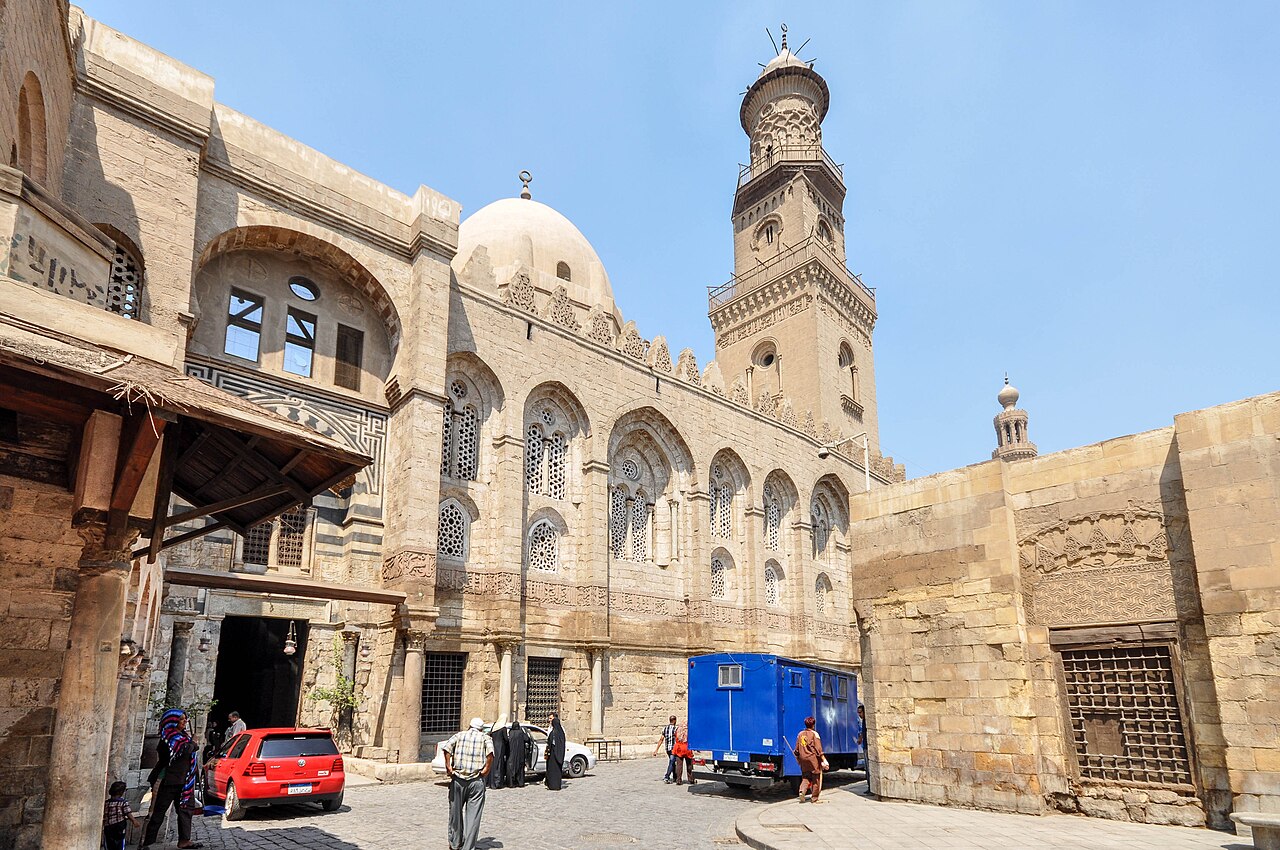
The minaret of the Qalawun complex in Cairo. Jorge Láscar from Melbourne, Australia, CC BY 2.0, Wikimedia Commons.
The hollow is the house
In plan, the solid is the least of these buildings. The Azem Palace "is constructed around three courts" and meets the street with "a bare wall with generally no windows and has one or two doors". The Nur al-Din hospital is "a symmetrical disposition of four iwans around a central courtyard", 20 by 15 metres, with a pool in the middle. Qalawun's hospital kept its four iwans and their waterspouts; his madrasa "features a courtyard in the center". House, hospital and school are one figure: rooms around a piece of sky.
The void did the work. A 2019 Al Jazeera piece on the Damascene house quotes Hala Qasqas of the Faculty of Fine Arts in Damascus: the houses "open towards the inside (the heart) rather than the outside (the world)". They were built touching, "in narrow, crowded lanes, to reduce the surfaces exposed to the sun", and the difference in pressure and heat between street and court set up cooling currents of air. You came in by a narrow, bent passage that cut you off from the street. The iwan, two storeys high, stood on the south side; opposite it the qa'a, a "winter reception chamber" with "a raised seating area (tazar)".
Beyond the door the void was graded, not ended. A disputed street, says the hadith, "is made seven cubits"; Besim Hakim reads that as room "to allow two fully loaded camels to pass", 3.23 to 3.50 metres. Lanes and cul-de-sacs were "semi-private roads, pertaining only to the surrounding properties", left alone "as long as owners along them were in agreement"; in Medina a cul-de-sac is simply a hawsh, a courtyard. The strip before a door, the fina', belonged "to whoever has a door opening onto the street" and held unloaded goods and benches; Hoshiar Nooraddin notes the word means "spaciousness" and covers court and yard alike. So the law O'Meara describes could raise a man's windows to about 220 cm and refuse a door opposite a door: it dealt with "the medina's semi-private and public space only", and saw the house itself as an absence to be kept from overlooking.
What the concrete city lost
Here the piece stops reporting and starts arguing. Steel and reinforced concrete can be poured anywhere and belong nowhere. They need no local quarry, no mason who knows the stone, no poplar beam, no neighbour's consent and no endowment to keep a fountain running at the door. A concrete block in Damascus does not know it is in Damascus: its walls are thin, its courtyard is gone, and the comfort that thick walls and a shaded court once gave is bought back with electricity. That is a claim, not a finding. One detail is a finding: a 2014 Lund University thesis on Damascus notes that the city's existing planning regulations "have no requirements for shading for pedestrians". The old lane needed none. Two things suggest it is not nostalgia.
Kindah Mousli's 2016 doctoral thesis at Bologna combined measurements in traditional Damascus houses with simulation, and estimated that applying their passive techniques, massive walls and natural ventilation, to new flats would give a "30–45% reduction of energy needs at Damascus". Modelled figures, but figures.
And it has been tried. Hassan Fathy built the village of New Gourna near Luxor "without the use of more modern and expensive materials such as steel and concrete", in mud brick with courtyards and vaulted roofs, and taught the villagers to work the bricks. How the village fared afterwards is another story.
What a Syrian city could do now
Small things, in the spirit of the sabil at Qalawun's gate.
Photograph and transcribe the endowment inscriptions still on Syrian khans, fountains and gates, starting with Khan al-Atna.
Find where Syrian waqf deeds survive, in the court registers Azab used, and publish what they say a building was for.
When a damaged house in an old quarter is rebuilt, use the stone, earth and timber it was made of, and a mason who knows them, before cement.
Bring back the sabil: a public tap on a street, kept by a neighbourhood fund, the donor's name on it. Mandaville's returning emigrant is a model for the diaspora.
Pair water with school, as the sabil-kuttab did: one small building, public use below, a classroom above.
Measure before arguing: one summer, one old courtyard house and one new flat on the same street, a thermometer in each.
What this piece cannot show
I could not read فقه العمران; the interview and the review are by and about one author. Mandaville's article is a 1973 magazine piece without figures. The Qalawun pages rest on medieval chroniclers and do not settle who was admitted: Al Jazeera summarises Azab as saying endowed health care covered everyone, "rich or poor, citizen or stranger", while the Qalawun project, citing Ibn Habib, says the hospital took all Muslims, military and civilian, with no limit on stay, and did not admit Jews or Christians as patients. The endowment deed would settle it; I have not seen it. No source measures how much came from ordinary donors against rulers. The materials described are those of Damascus, not every Syrian town, and Mousli's numbers are modelled. Mandaville also warns that many endowments served a donor's family first and the poor only when the line died out. This is an AI-assisted reading of published sources, and should be read as one.