What field measurements in Beni-Isguen and Fez found about narrow streets and summer heat
In summer 2003, a team led by Fazia Ali-Toudert of the University of Freiburg carried instruments down the hillside of Beni-Isguen, an old walled city in Algeria's M'zab valley. They stopped at eight places between the upper lanes and the market square. At each one they recorded air temperature, humidity, wind, and the heat reaching a person standing there. The question is one that anyone working on an old city's streets might ask: do tall walls around very narrow lanes keep people cooler, and by how much?
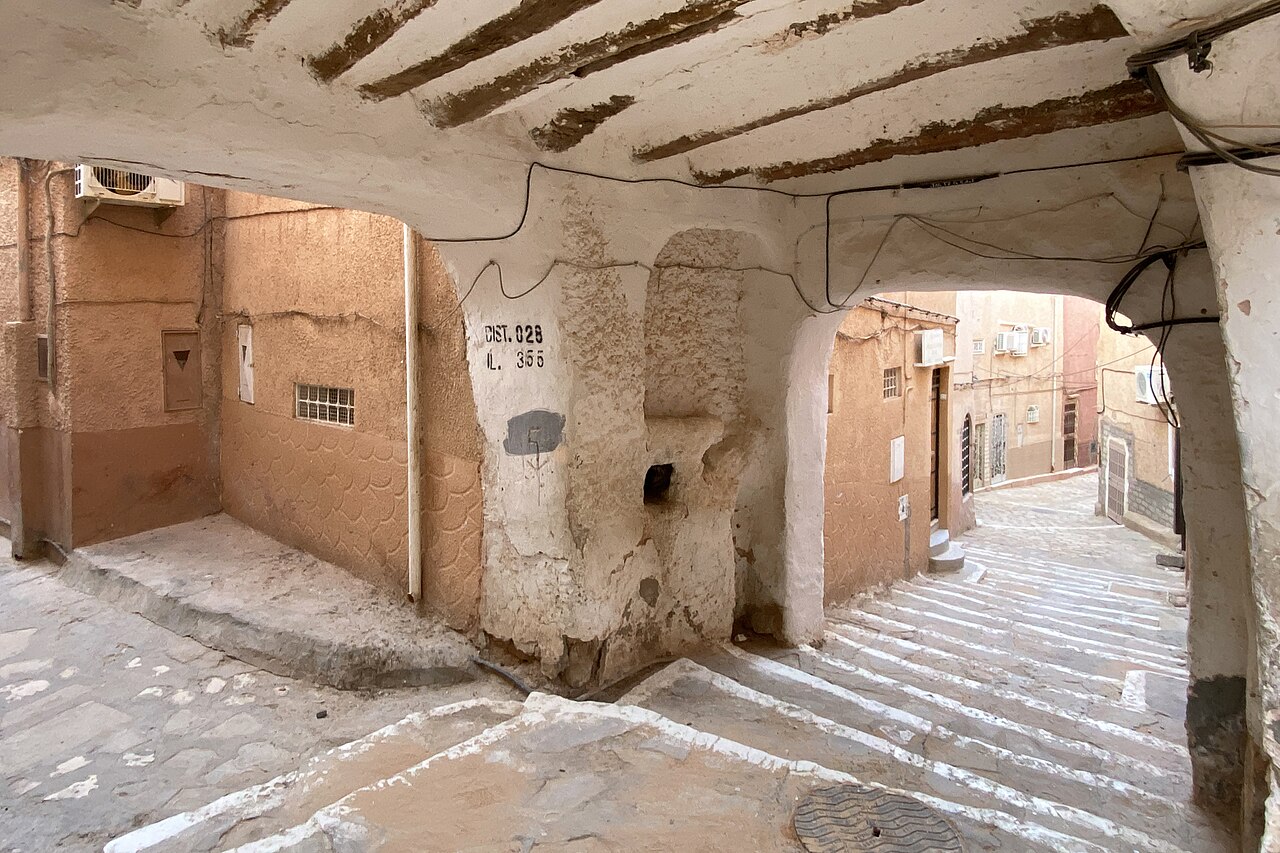
A covered passage in the walled town of Beni Isguen, Algeria: a low whitewashed ceiling on timber beams over a junction of stepped stone lanes between earth-coloured houses. Bernard Gagnon, CC BY 4.0, Wikimedia Commons.
Eight stops on one route
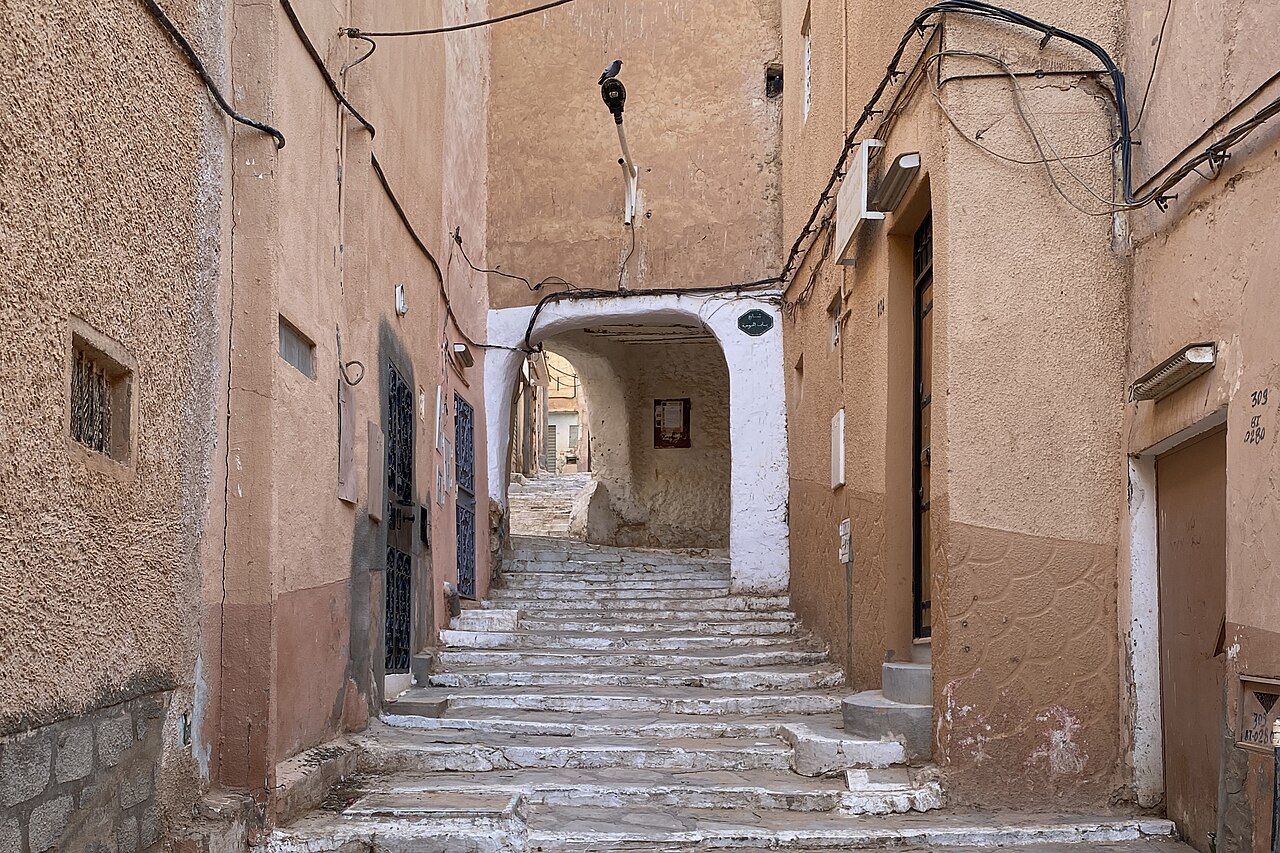
The lanes were very narrow, and the buildings beside them stood from 0.6 to 7.5 times as high as the lane is wide. The walls were heavy stone. One stop was a covered passage; the open market square served as the reference point. The team measured from 6:00 to midnight, spending about 15 minutes at each stop, on two days of the same summer.
The finding concerns the body more than the air. The team converted its readings into PET, an index that expresses what a standing person would feel as a temperature. In the afternoon sun, at the market square and at the widest lane, PET reached 53 to 55°C. In the covered passage the lowest value was 37°C. The authors conclude that shade from high walls is an efficient way to reduce discomfort at street level, and that covered streets did best.
Air temperature gave a weaker signal. At its peak, the air in the shaded lanes was only 2 K cooler than in the open, and the team found no clear link between a street's height-to-width ratio and its air temperature. The deepest lane, at the edge of the city, was "not as cool as expected", which the authors think is likely due to air mixing with exposed ground nearby. A thermometer in the lane would therefore have understated the difference the shade made. The difference was in the sunlight and in the heat radiating from surfaces.
What the heavy walls cost at night
Thick stone and deep lanes also hold heat. The authors write that when high thermal capacity is combined with high aspect ratios, heat leaves the lane surfaces slowly after dark and delays the cooling of the city. They add that this would prolong discomfort inside houses at night, a point they take from earlier work. Their own night readings show little difference between lanes: after 21:00 the air averaged 32.5°C in all of them. The open square cooled faster and was 1.5 K cooler by midnight.
The study has limits its authors state. It describes a typical summer day, PET is a calculated index, and the team did not survey residents about how hot they felt.
A narrow stepped lane between tall plastered walls in Beni Isguen, Algeria, climbing to a whitewashed arch where a building spans the lane. Bernard Gagnon, CC BY 4.0, Wikimedia Commons.
Fez: a deep street and a shallow one, summer and winter
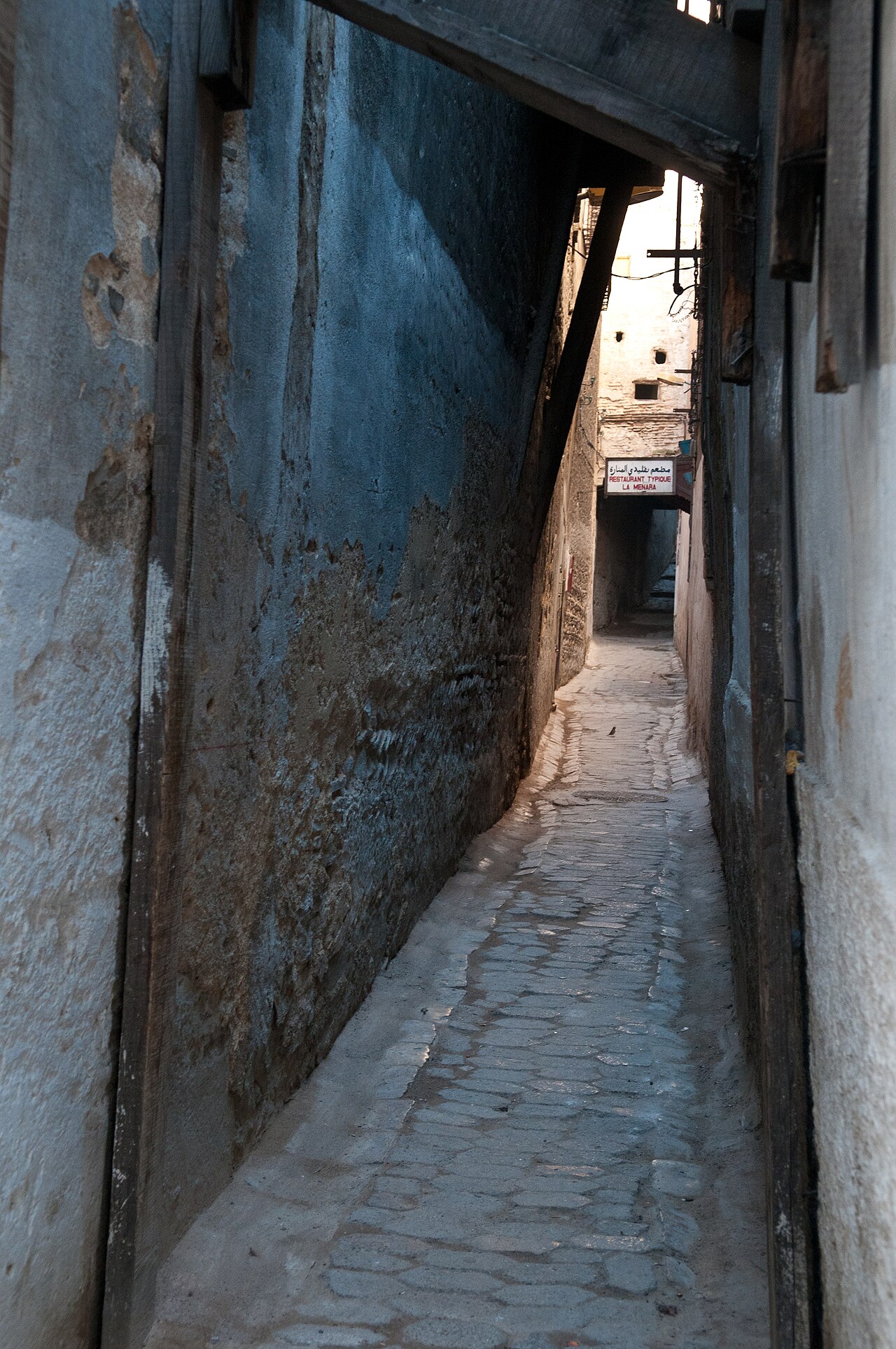
Erik Johansson of Lund University measured continuously through a hot summer and a cool winter in Fez, Morocco, in one extremely deep street and one shallow street. By day in summer the deep street was much cooler: the largest daily difference averaged 6 K and reached 10 K on the hottest days. The PET assessment suggests the deep street was fairly comfortable in summer and the shallow one extremely uncomfortable.
In winter it went the other way. The shallow street was the more comfortable, because sun could reach it. For a city with a cold season, Johansson's own reading is that some wider streets or open spaces give access to winter sun. Syria's inland cities have cold winters too, so the Fez result may weigh as much as the Saharan one. Beni-Isguen's measurements cover summer only.
What exists for Syrian cities
A 2013 paper in the Journal of Housing and the Built Environment tested street designs in Damascus using the ENVI-met simulation program, not field measurements. It found that aspect ratio, orientation and trees all strongly affect ground-surface temperature and comfort in streets lined with attached buildings. For streets of detached buildings, orientation and aspect ratio mattered little and vegetation mattered a great deal. A Lund University thesis on Damascus combined measurements and interviews in summer and winter, but mainly studies modern districts rather than the old city. I could not open any source that measures shade in the lanes of Old Damascus or Aleppo, so the Algerian and Moroccan numbers cannot be read across directly. Humid coastal towns such as Latakia are a different climate again, and none of these studies covers them.
A very narrow, deep alley in the medina of Fez, Morocco, between high walls held apart by timber braces overhead, January 2011. Michal Osmenda from Brussels, Belgium, CC BY-SA 2.0, Wikimedia Commons.
Masdar: shade planned into streets wide enough for vehicles
Masdar City in Abu Dhabi tried to keep the shade of old streets while allowing vehicles. According to a 2016 comparative study in Architectural Science Review, its streets are limited to 14 m for main streets and 8.5 m for secondary ones, and the upper storeys project outward so that the street is narrower at ground level. That paper describes the design and reports no measurements. The Guardian reported in 2016 that less than 5% of the original plan had been built, so there is little built street to measure. I found no study of how cool the finished streets are.
What is still open
How much of the Beni-Isguen result survives in lanes of a different width, wall material and orientation is not known from these sources. Nor is it known how the trade-off between summer shade, winter sun and vehicle or emergency access has played out in practice anywhere.