What community-run catch-up classes achieved in Nigeria and Liberia, and what they cost
Syria's education ministry says it has finished renovating 1,003 schools and is working on another 1,015. On 1 October 2026 UNICEF said that communities taking in returning families are under growing pressure on their schools, and the EU Agency for Asylum reports that education in Syria remained severely disrupted as of May 2026, especially in the northeast and in areas with many returnees.
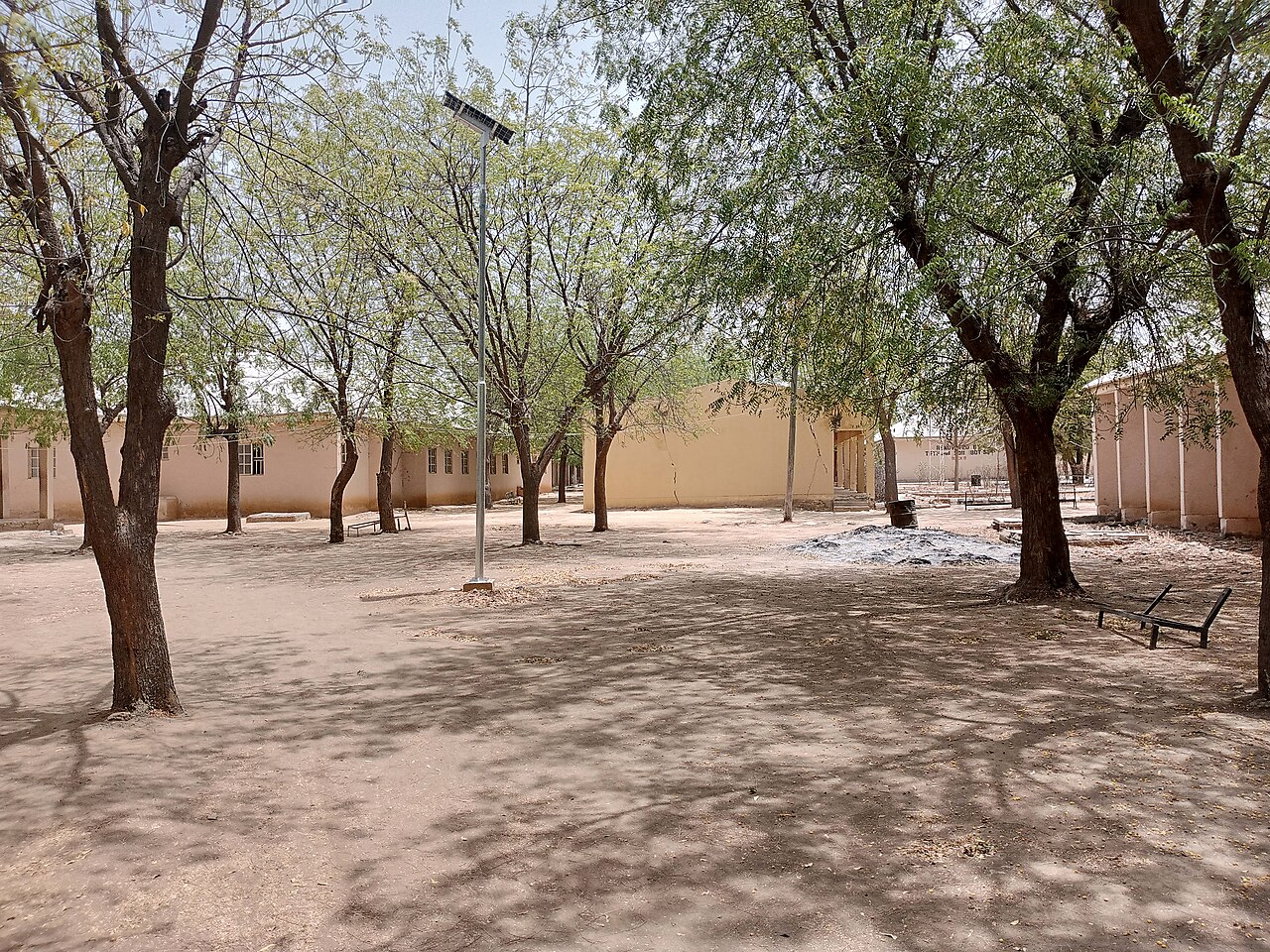
Single-storey school buildings and shade trees around an empty sandy yard at a school in Gashua, Yobe State, Nigeria, March 2023. Musa maidala, CC BY-SA 4.0, Wikimedia Commons.
Repaired buildings are one part of the picture. The other is how children who lost years of schooling catch up, and who teaches them. In Nigeria and Liberia, programmes trained ordinary community members to teach children who were out of school, and the results were studied in detail.
Nigeria, 2017–2018: £66 a child, and coaching that did not help
The International Rescue Committee and Creative Associates ran accelerated learning classes, often called catch-up classes, in Yobe and Borno. They were for children who had never attended school or had been out for more than two years. The teachers were community members, trained as "learning facilitators". The 370 facilitators received four days of training, then taught three hours a day, three times a week, for nine months. They met regularly in "learning circles" to swap ideas. The IRC's cost brief puts the price at £66 per child, covering the centres, training, materials and the organisations' own overheads.
In the randomised evaluation, numeracy rose by roughly 0.3 standard deviations, a standard measure of change in test scores. Reading fluency and comprehension improved too, though only two of five reading measures showed a measurable difference.
One group of facilitators also got regular coaching visits. Their pupils did slightly worse than those taught by facilitators without coaching, and the coaching added £42 per child. The IRC's own explanation is that the coaches knew little of the content they were meant to support and were seen as supervisors, not helpers. The IRC says it will prioritise coaching only where coaches are not supervisors and can build subject knowledge. What does a coaching visit look like when the coach is a colleague and not a supervisor?
Nigeria, 2018–2021: more than 900 centres
A larger programme, run by FHI 360 with USAID funding, opened more than 900 learning centres for children aged 6 to 15 in 180 communities. It taught a condensed curriculum in Hausa and Kanuri as well as English, with attention to children who had witnessed violence. Girls were 53 per cent of learners in the first year and 59 per cent in the last.
A summary published by Education.org says the end-of-programme evaluation found that the share of learners who could read 30 words a minute rose from 13 to 30 per cent. That figure comes from the summary, not from the 2021 evaluation itself, which I could not open. The programme's compressed curriculum was officially adapted into Nigeria's national Accelerated Basic Education Program, which suggests how a link with the school system can be built.
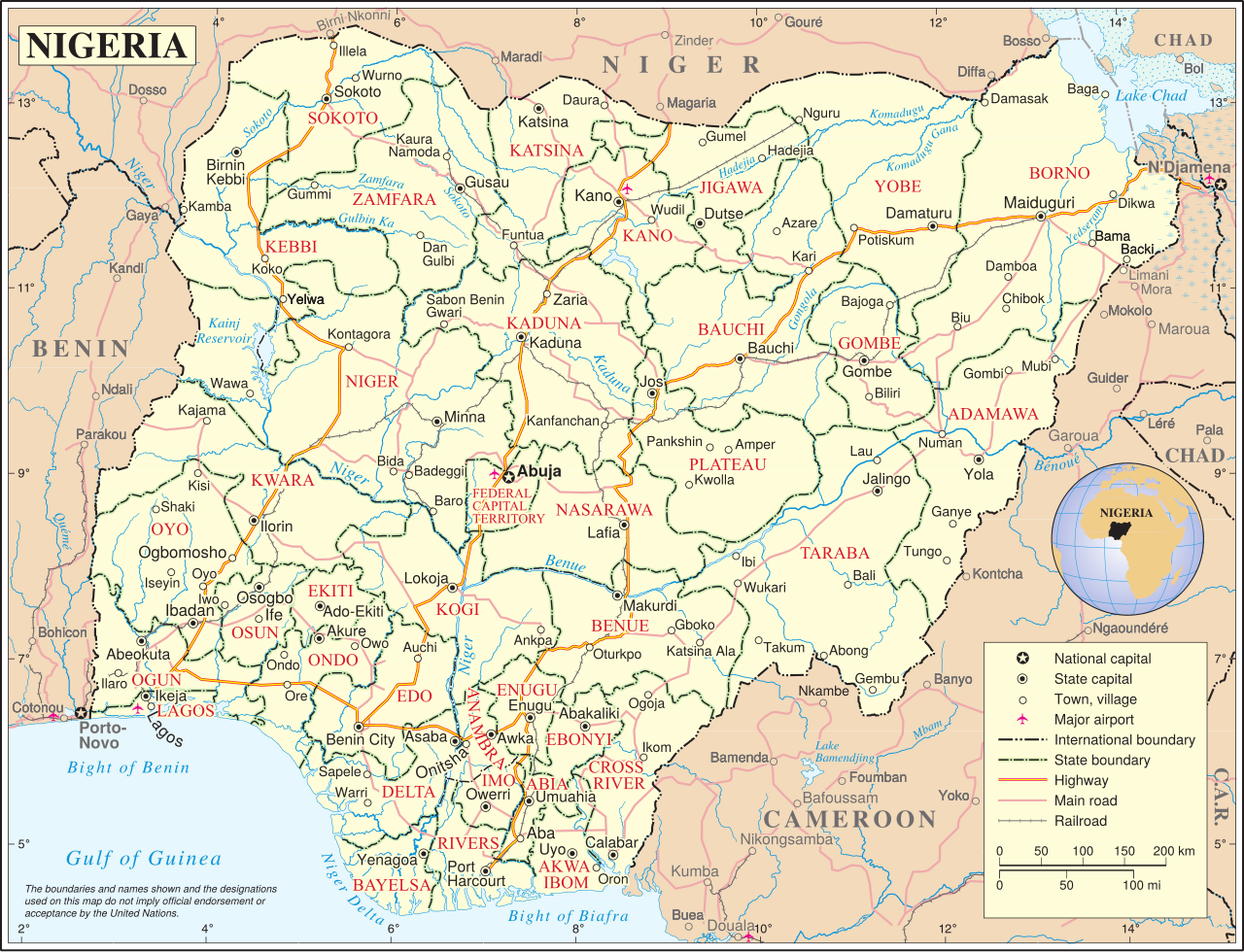
Map of Nigeria showing its states, including Yobe and Borno in the north-east with their capitals Damaturu and Maiduguri, plus main roads and neighbouring countries. United Nations Cartographic Section, Public domain, Wikimedia Commons.
Liberia, 2022–2024: 49 communities with the programme, 49 without
The Luminos Fund's programme also recruits its facilitators from each community, gives them 25 days of training a year, and has supervisors monitor them. IDinsight compared 49 communities that had the programme with 49 that did not. A year after the children finished, 75 per cent of them were enrolled in school, 15 points more than in the communities without it. Large gains in reading and numeracy were still there a year after the children graduated.
The control group caught up as well. Enrolment among children in the communities without the programme rose from 32 to 60 per cent over the same period, and a year after graduation the programme's effects were 10 to 15 per cent smaller than at the first check for most reading and maths measures. The evaluators cannot explain all of the rise in the control group, but they believe enrolment in government schools accounts for much of it. When the control group enrols anyway, how should a catch-up programme's value be measured?
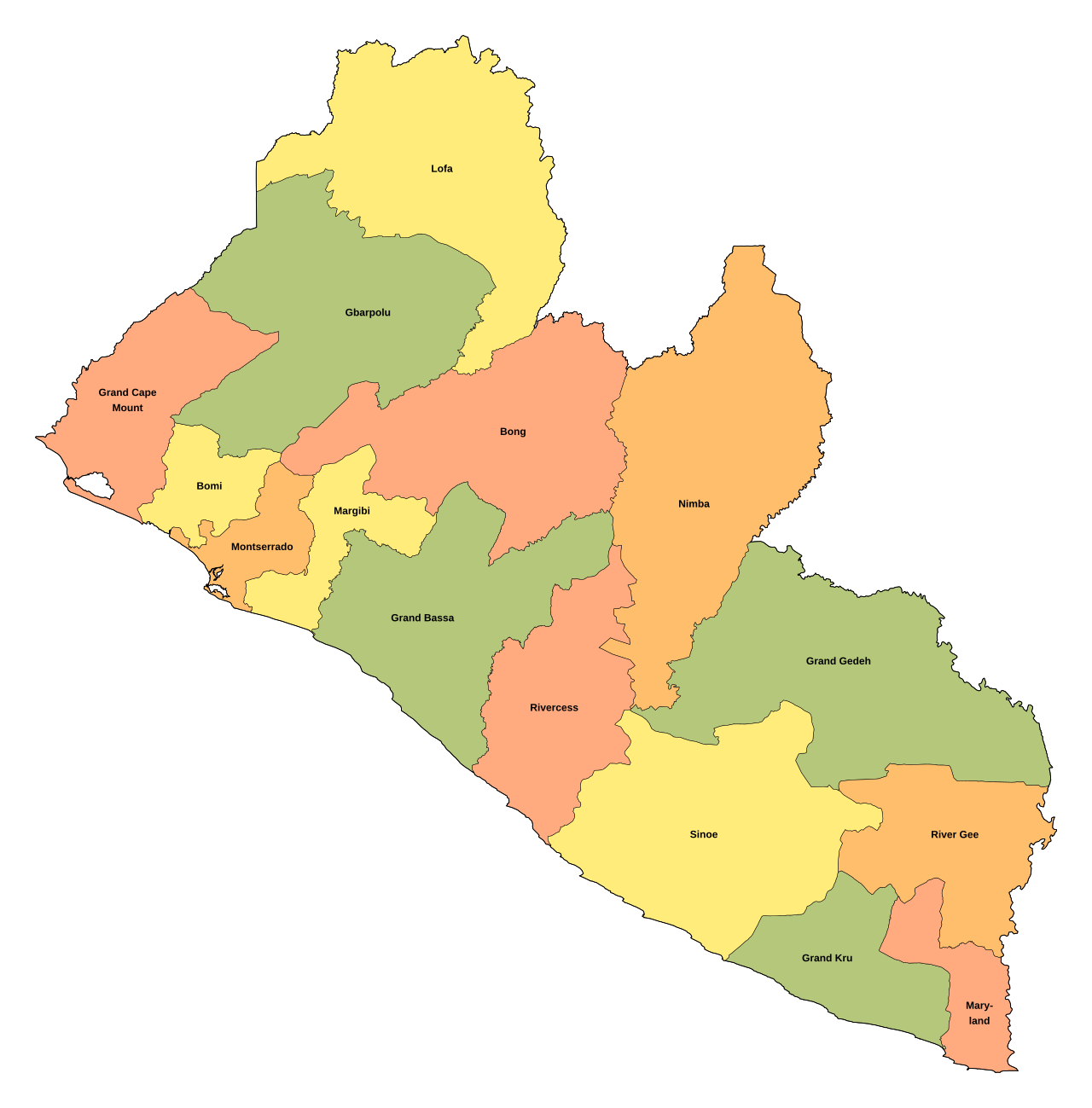
Map of Liberia showing its fifteen counties, from Grand Cape Mount in the north-west to Maryland in the south-east. Kaythehistorian, CC BY 4.0, Wikimedia Commons.
What this could mean in Syria
Syria's education ministry says it has reinstated more than 15,000 teachers dismissed under the previous government, so catch-up classes in Syria might work alongside the school system, not outside it.
But the settings differ. Baseline enrolment was much lower in Nigeria and Liberia, and the languages and security conditions were different. Returnee children in Syria also face problems these programmes did not address, such as missing documents, curriculum differences for those returning from abroad, and the cost of school and transport, all reported by the EUAA.
The sources say little about the facilitators' own experience. Credit for the results belongs to the facilitators and to the communities that hosted the centres, but the evaluations measured children's scores, not what the work did for the facilitators. Which skills (teaching, mentoring, translation, bookkeeping, repairing a room) did the successful centres draw from the community, and which did they have to bring in? How long do short volunteer-led classes need to run before children can re-enter a regular grade?
A note on the sources. The IRC brief is from the organisation that ran the programme, though it reports a randomised study. The Liberia report is by independent evaluators commissioned by the Luminos Fund. The Syrian ministry's school figures come from a news report of a ministry statement. A separate July 2026 report on a learning-recovery programme in Raqqa could not be opened and is not used. I found no study of volunteer-led catch-up classes in Syria itself.