Kerbstones out of the rubble
A woman who works at a debris recycling facility in Aleppo told a staff member of the UN Development Programme (UNDP) this year that before the project she had no income, and that she can now buy food and medicine for her children, niece and nephew. The account is in a UN News "First Person" piece from August 2026. UNDP's REVIVE project is clearing 570,000 tonnes of debris across Aleppo, Deir-ez-Zor, Homs and Rural Damascus, and more than 1,300 people had taken part in its cash-for-work activities linked to debris removal.
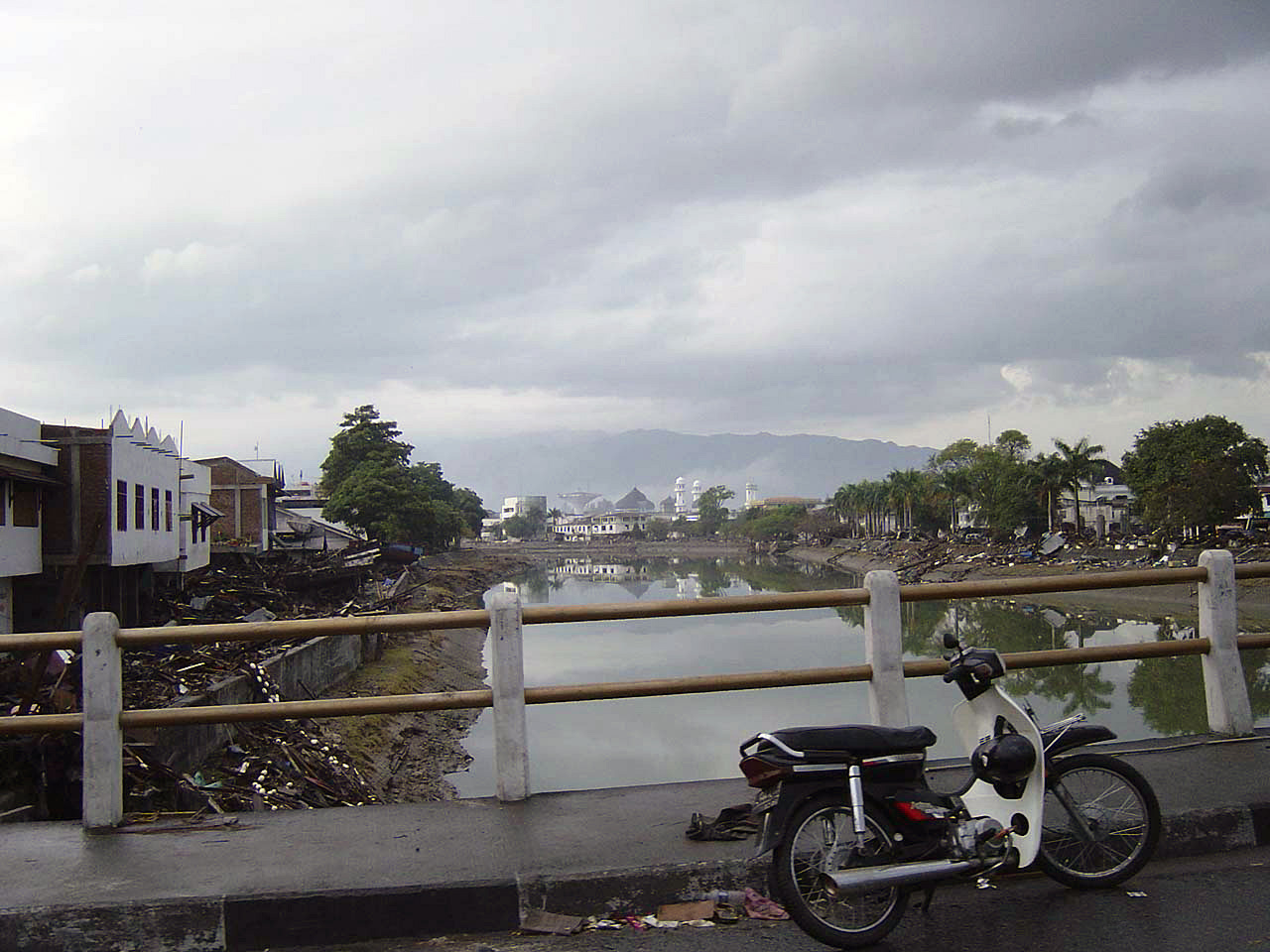
Debris and trash lining the banks of a river near downtown Banda Aceh after the 2004 tsunami. Michael L. Bak, Public domain, Wikimedia Commons.

Elsewhere in Syria, the Saudi agency KSrelief and the Syrian Civil Defense started a project in Douma and Darraya in December 2025 to remove at least 85,500 cubic metres of debris, with a recycling unit able to turn about 30,000 cubic metres of rubble into construction materials, according to Arab News.
Three earlier cases did the same kind of work, in different decades. What follows is what each one reports, and how much weight the report can carry.
Bricks at half price
In late 1946 the Office for the Reconstruction of the Capital in Warsaw argued that salvaging materials from the ruins was the cheapest way to get building material. An architectural historian, writing in ARDETH, found that small building firms were already doing it, without a plan. The price list of a trade journal shows why. In May 1946 a thousand new bricks cost 3,500 zloty and a thousand salvaged ones 1,800. In 1948 the figures were 7,400 and 4,800.
Two limits. The prices come from one trade journal, quoted by the historian, and say nothing about labour or quality. The historian adds that the list leaves out bricks that were simply taken from empty ruins, so the true amount of salvage was larger than the prices suggest. In 1947 two Warsaw engineers travelled to Hamburg to see how a research association there organised rubble recycling, and wrote about it on their return.
A road, 12,000 pieces of furniture, and a market
Banda Aceh had its own mountain of debris after the 2004 tsunami. UNDP's waste programme there was assessed by two independent evaluators, Philip Rushbrook and Saediman Mboe, whose final report is dated March 2013. They judged that the US$41 million spent was justified.
Their count of what the recovered material did: it rehabilitated 100 km of roads, and wood from demolished houses became 12,000 pieces of furniture in a carpentry training scheme. In 2005 the programme paid for 400,000 days of temporary labour clearing debris, sweeping streets and clearing drains.
The part of the report most useful to anyone planning something similar is about the recycling businesses that grew around it. The programme gave small grants for equipment, business training and encouragement to make higher-value products. Two years after support ended, about two-thirds of those businesses were still operating. The evaluators attach a condition: they say the approach can be repeated where there is a market for the recycled material, and they found a dependable one in the city of Medan.
They also record a gap. Women's involvement was "fortuitous rather than managed".
Mosul's plant, and what its tests covered
In Mosul, the International Organization for Migration (IOM) and the UN Environment Programme (UNEP), with Japanese funding, built a debris recycling centre and handed it to the municipality on 28 July 2022. The press release puts the debris from the conflict with ISIL at an estimated 55 million tonnes. The project recovered and sorted nearly 25,000 tonnes, and crushed about half of it into aggregate. By simple division that is less than one tonne in a thousand.
The aggregate was tested, and the test results were endorsed by a national structural testing centre: it met the Iraqi design standard for the foundation layers of roads, and suited low-strength uses such as concrete blocks and kerbstones. Construction firms in Mosul said they were interested in buying it.
This is the agencies' own release. It describes what was built and tested in 2022. It does not say whether the plant kept running afterwards or whether anyone bought the aggregate, and no independent evaluation turned up in the search for this piece.
What is different in Syria
The Aceh and Mosul reports do not discuss a question that Syrian sites meet often. A January 2026 opinion piece in Syria Direct says that human remains are found in rubble across Syria, and that local reports on rubble recycling do not mention any procedure for checking for them. It is an opinion piece, and what procedures exist on the ground is not something these sources settle.
The KSrelief project says one aim is to reduce the danger of unexploded ordnance, which was not part of what the Aceh evaluation measured.
A number of Syrian rubble estimates and cost per cubic metre circulate in the press. The pages that carry them could not be opened with the tools used here, so none appear in this piece.
Still open
Who buys the crushed material in Syrian cities, and at what price per tonne, has not been published in anything found for this piece. Neither has the share of cleared rubble that goes back into construction rather than to a dump. In Aceh, the evaluators tied the survival of the recycling businesses to the existence of a buyer.
Sources and further reading
- UN News, "First Person: Syrians lead efforts to clear rubble and rebuild lives" (16 August 2026)
- Arab News, "KSrelief launches debris removal project in Syria" (2 December 2025)
- ARDETH, "Mining for Embodied Coal. Building Material Reuse in the Postwar Reconstruction of Warsaw"
- UNDP, "Tsunami Recovery Waste Management Programme: Independent Assessment and Evaluation, Final Report" (31 March 2013)
- UN Iraq, "Mosul's recovery moves towards a circular economy" (28 July 2022)
- Syria Direct, "Op-Ed: Remains in the rubble: Integrating rights of the missing into Syria's reconstruction policies"