What a slime mold can teach us about designing networks
A rail map of Greater Tokyo is a network design problem that has been solved the hard way: many lines, many operators, decades of planning, and the cost of every tunnel argued over. Now imagine handing the same problem to an organism with no brain, a single cell, and a handful of oat flakes.
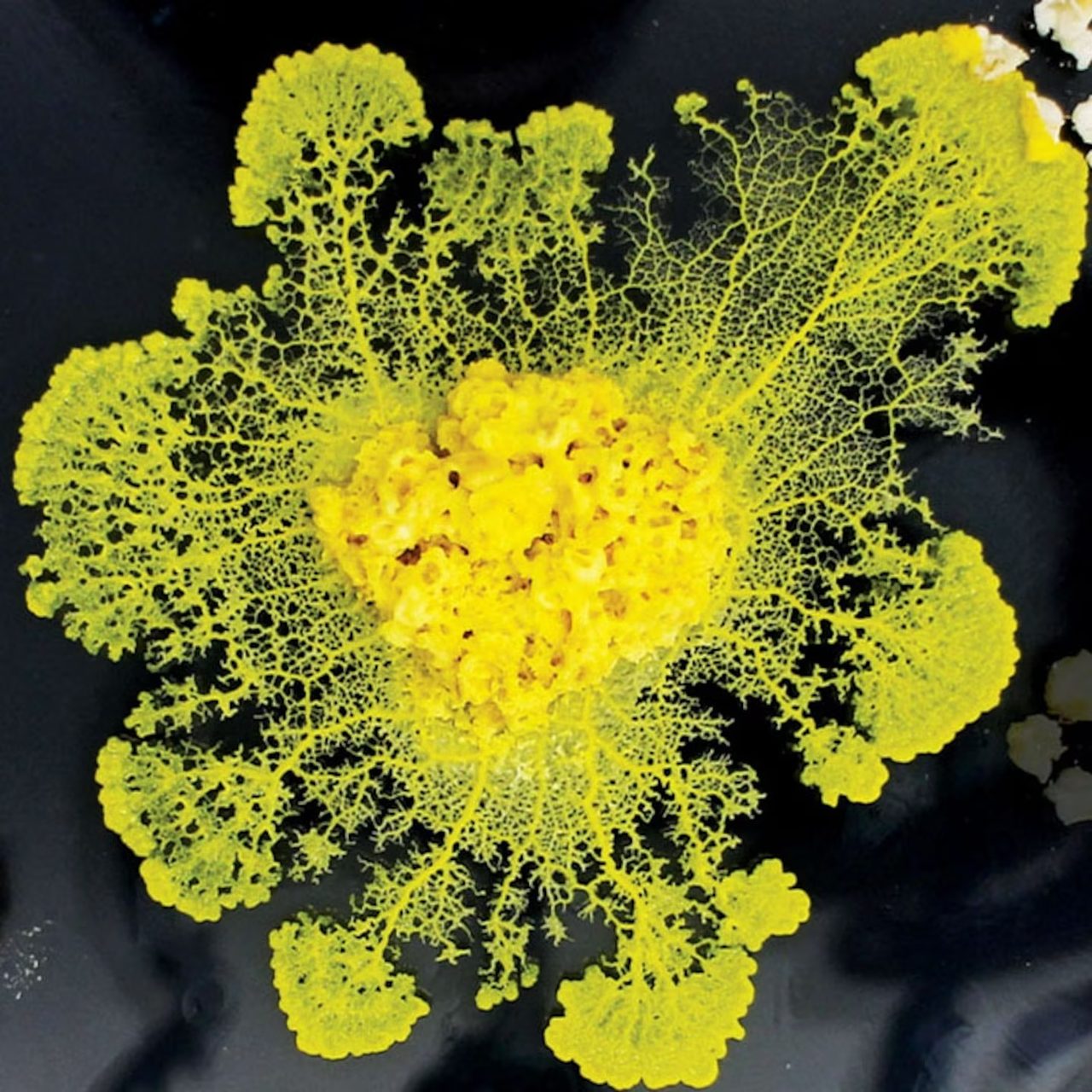
A Physarum polycephalum slime mold on a dark surface: a yellow body with a fine network of tubes spreading outwards, oat flakes at the edge. From the Data-Driven Design workshop presentation; original credit to be confirmed.
A day in the life of a Tokyo network
The organism is a slime mold, Physarum polycephalum. In a 2010 study published in Science, researchers placed 36 food sources at the positions of the cities around Tokyo and started the slime mold at Tokyo itself. Light, which the slime mold avoids, was used to keep it off the sea and the mountains.
Then they watched. The slime mold first spreads everywhere, a sheet of tubes reaching for every food source. Over the next day it thins out: tubes that carry a lot of flow grow thicker, and unused ones disappear. What is left is a network.
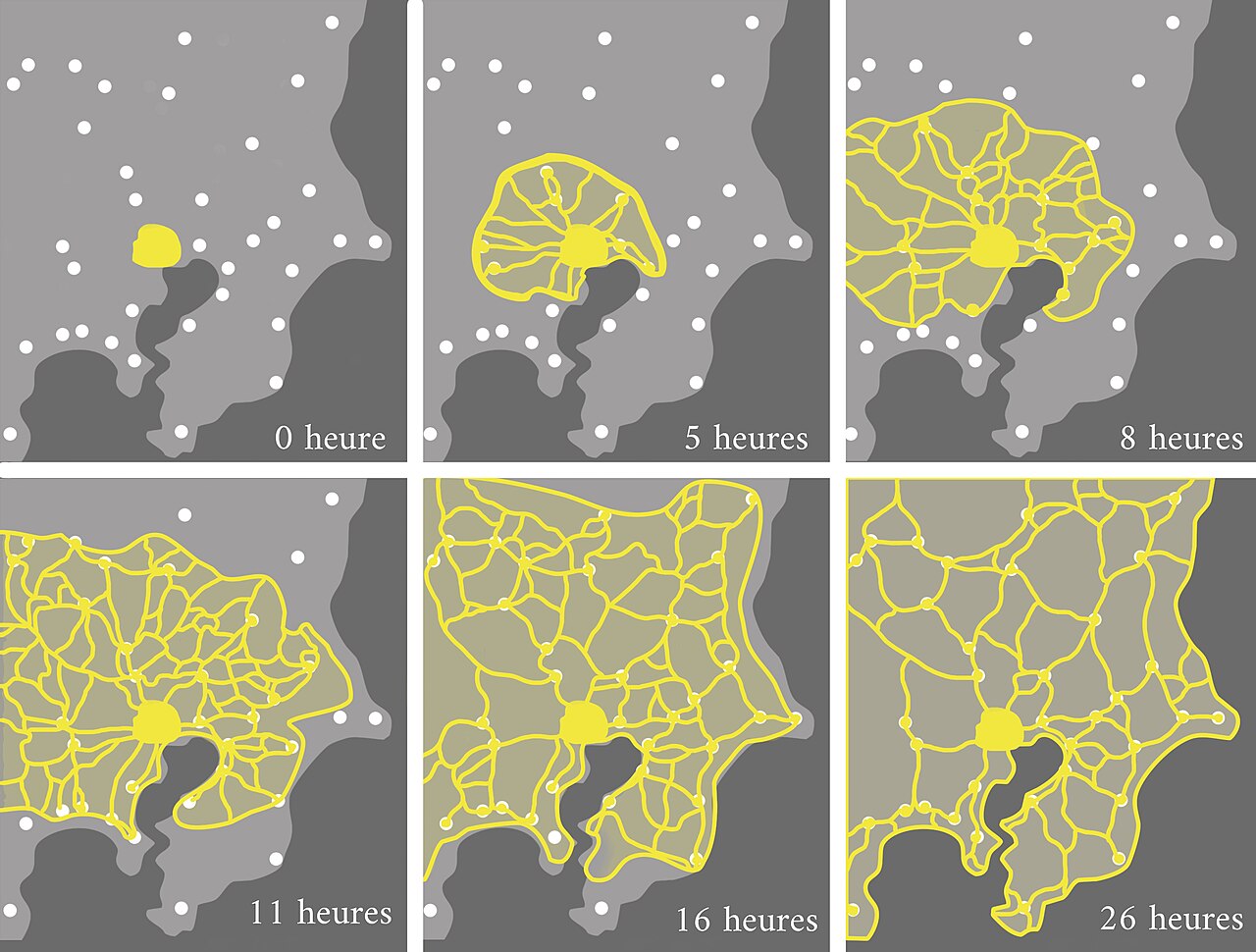
Six stages, from 0 to 26 hours, of a slime mold growing a network between food sources placed like the cities around Tokyo, redrawn from the Tokyo experiment (the labels are in French). Tim Tim (VD fr), CC BY-SA 4.0, Wikimedia Commons.

That is the story that gets retold, usually with the line that the slime mold "designed Tokyo's railways". Here is what the measurements say.
Held against the real railway
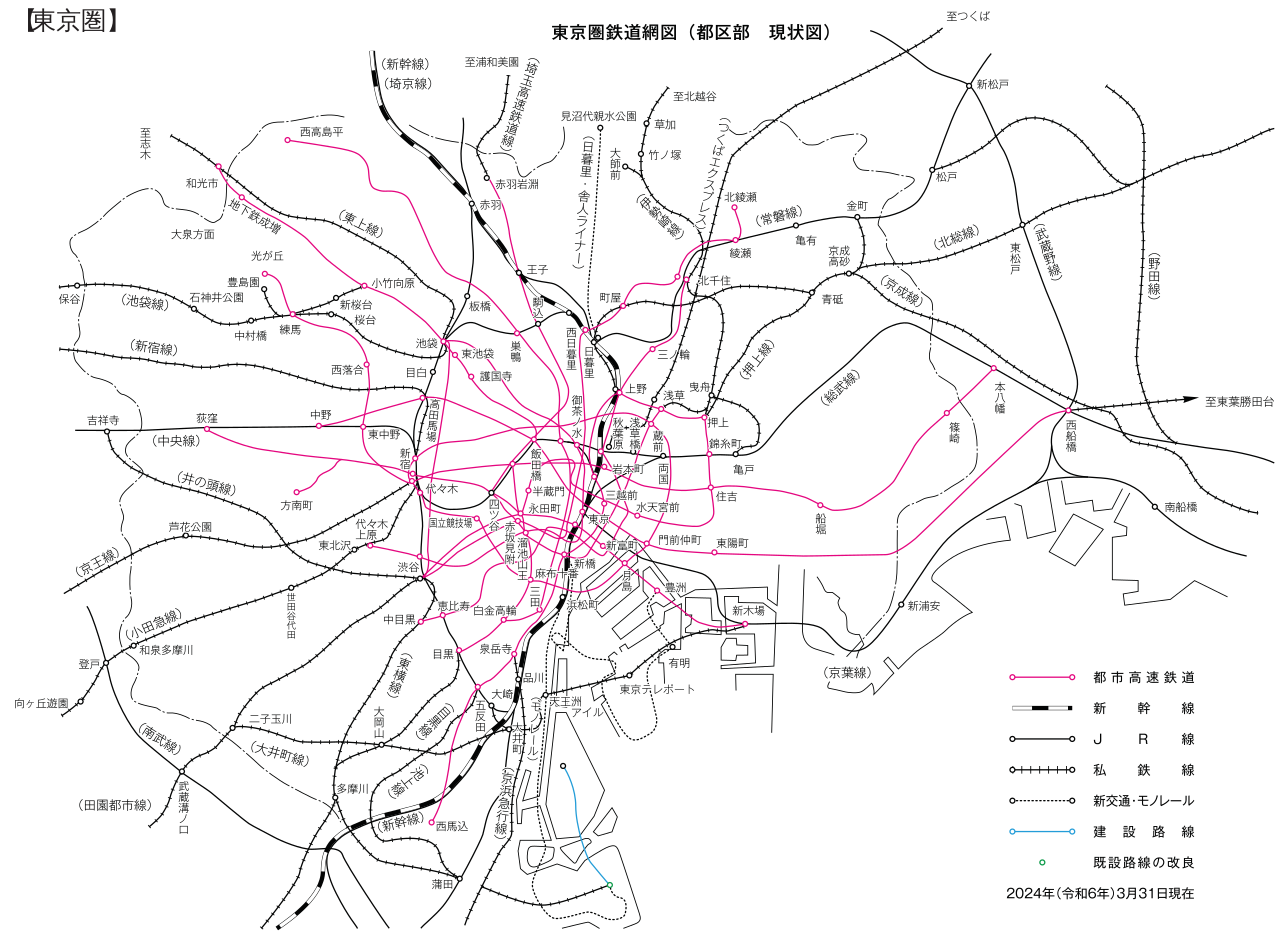
Map of the urban railway network of the Tokyo area, from Japan's Ministry of Land, Infrastructure, Transport and Tourism. Ministry of Land, Infrastructure, Transport and Tourism (MLIT) , Japan, CC BY 4.0, Wikimedia Commons.

Researchers compared the slime mold's networks with the real rail network:
| Measure | Slime mold | Rail network |
|---|---|---|
| Cost (relative to the minimum spanning tree) | 1.75 | about 1.8 |
| Transport efficiency | 0.85 | 0.85 |
| Share of single-link failures that disconnect part of the network | 14-20% | 4% |
So the slime mold matched the railway on cost and efficiency, but its networks were less robust: the real railway is much better at surviving the loss of a single link. The slime mold does not find the shortest path or the best network. It grows a compromise, and a slightly different setup (the model's two parameters) slides the result between a cheap tree and a redundant mesh.
Common misunderstandings
- "It finds the shortest path." True for one food source and one exit in a maze. With many sources it builds a compromise network.
- "It is a faster way to optimise infrastructure." Not in the evidence. In a 2020 power-distribution study, the slime-mold method produced a starting layout for a normal optimiser, up to about 10% cheaper than a minimum spanning tree on average, but far slower to compute.
- "Slime Mould Algorithm" is a different thing. It is a general-purpose optimiser named after slime mold. It builds no networks, so it is not evidence for infrastructure design.
What the evidence supports
- The national-motorway comparisons are suggestive, but they have no random baseline for comparison, and I found no independent replication.
- The best-validated use is outside cities: reconstructing the cosmic web from galaxy data, checked against a dark-matter simulation.
- No transport agency is documented as using it in planning.
How designers use it
- As a candidate generator: a Toronto subway study used a slime-mold-style agent model to propose networks, then scored them on cost, travel time and vulnerability.
- As a co-designer or image-maker, for example in ecoLogicStudio's living-plate experiments.
- In Grasshopper through the Nuclei plug-in, or in Python with a short flow-conductivity model, using points of interest from OpenStreetMap as the "food".
The takeaway
A slime mold does not hand you the best network. It gives you a family of networks to choose from, with a visible price for each extra bit of resilience. That is a useful way to start a conversation with a client, as long as it is presented as a generator of options and not as proof of an optimum.
Sources
- Tero et al. (2010), Science 327:439-442, doi:10.1126/science.1177894
- Nakagaki, Yamada & Toth (2000), Nature
- Puvi et al. (2020), Energies 13(23):6278, doi:10.3390/en13236278
- Li et al. (2020), Future Generation Computer Systems 111:300-323, doi:10.1016/j.future.2020.03.055
- Kay et al. (2022), Scientific Reports
- Burchett et al. (2020), cosmic web