Coats off in the classroom
One winter in Suwayda, a pupil arrived at school carrying a canister of diesel. The heating fuel the education directorate was supposed to send had not come, and the classroom was too cold for him to concentrate. Syria Direct reported the story in October 2017. The principal said dozens of pupils had missed classes the year before for lack of fuel.
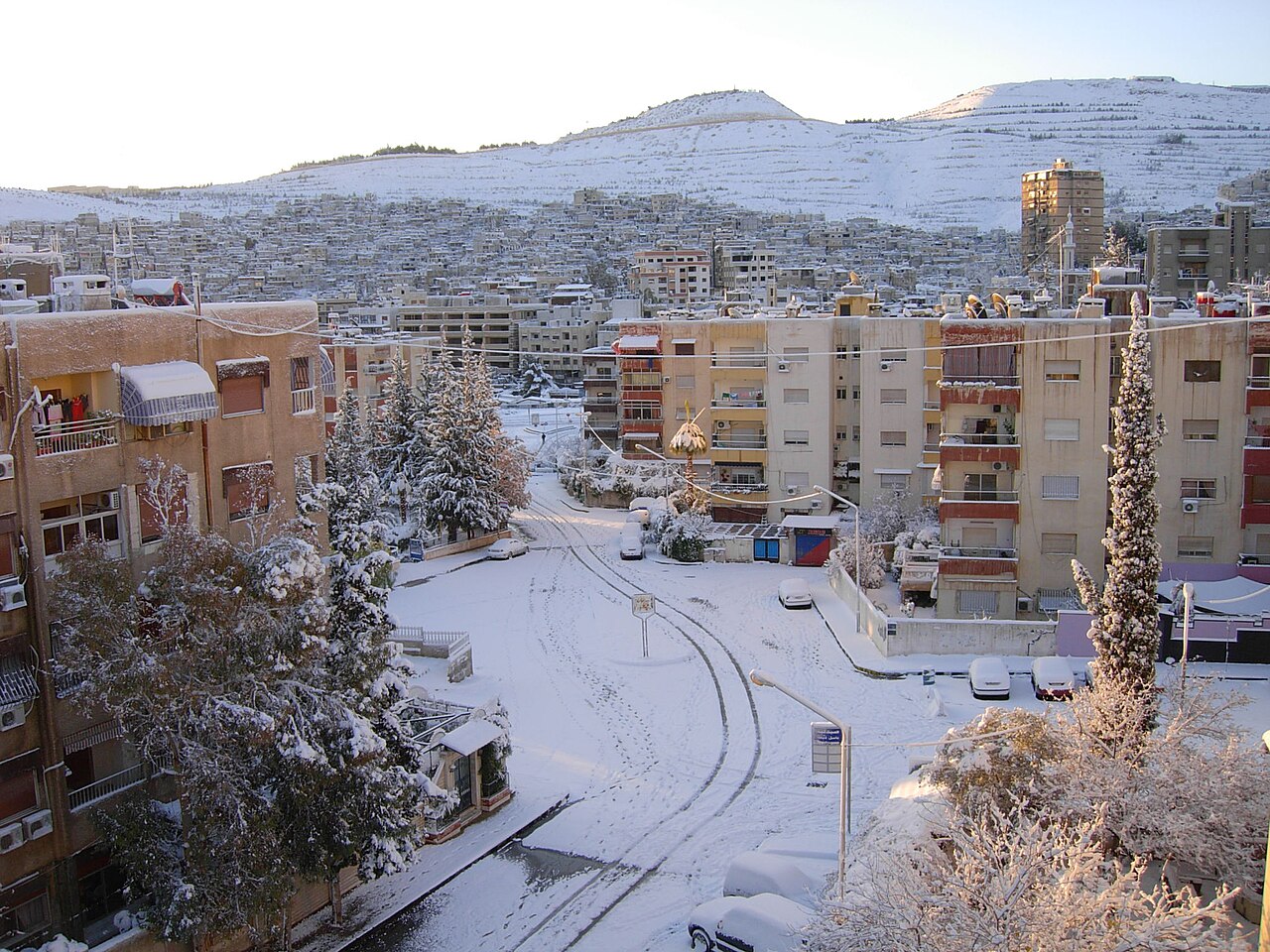
A residential street in Damascus under fresh snow, January 2013, with apartment blocks and snow-covered hills behind. Mohammad AL yakoub, CC BY-SA 3.0, Wikimedia Commons.

Nine years later the problem is still there. The UN's 2026 humanitarian plan for Syria counts nearly 8,000 schools, about 30 per cent of them not working. It says many of the rest have no fuel, heating or insulation that would keep winter learning safe. On the last day of 2025, a snowstorm led the authorities to suspend classes in several provinces, according to Anadolu Agency. In north-west Syria in 2022, a UN survey found that more than half of schools needed heaters and fuel. The same report noted that children struggle to learn in cold rooms and that parents may keep them at home.
The winter aid planned that year was mainly stoves and fuel, with some repairs to buildings. Other countries have tried a second approach: keeping in the heat a building already produces. Three of those efforts were checked by someone afterwards.
Ice on the inside walls
School No. 63 in Ulaanbaatar, Mongolia, is a 1975 building for disabled children. Before 2011, ice formed on some of its inside walls, the sports hall was closed because it could not be heated, and pupils kept their coats on in class. In another school on the project, north-facing classrooms sat at 8 to 9°C in winter.
Between November 2011 and December 2012, USAID paid $1.517 million and the German agency GIZ managed a retrofit of three school buildings. Mongolian architects and builders insulated walls, roofs and ground floors, fitted new windows and doors, and fixed drainage around the foundations.
USAID then sent two outside evaluators for eight days in December 2012. They found that the retrofits had turned "exceedingly cold, drafty, and leaky buildings" into warm ones. In one school, with the outside air at about minus 25 to minus 30°C, no pupil, teacher or staff member was wearing a coat. Parents and teachers at School No. 63 repainted the interior themselves, and neighbours had begun using the building after hours for sports.
The energy figure is weaker than the comfort finding. The evaluators estimated that heat loss would fall by about 40 per cent a year, but that number comes from a model. The project installed a heat meter at one school and then did not monitor it, so nobody measured the actual saving.
A boiler that would not light
The evaluators also listed what went wrong, which makes the report more useful than a project brochure.
The new boilers at two of the schools did not work properly. They had been chosen to burn wood or coal, but logs of the right size were hard to find and the local coal was lignite. The old boilers had to be put back in for the winter.
In one building the radiators had no valves, so the only way to cool an overheated room was to open a window. One classroom measured 30°C. A warm, crowded, sealed building also produced heavy condensation on the windows, probably from moisture leaving masonry walls that had soaked up rain during the works and from ventilation designed for fewer pupils. Insulation changed how the buildings handled air and water, and the design had not allowed for it.
Half the bill from the district fund
In Arkhangai province, in central Mongolia, average winter temperatures are around minus 14°C. From 2019 the French NGO Geres worked with the provincial government. It surveyed 241 public buildings in 18 districts and found most roofs and floors poorly insulated.
In 2021 a nursery school in Undur-Ulaan was insulated. Geres and a local partner first trained the building firm's workers. The district and provincial authorities, Geres says, paid about half the cost from the local development fund. Geres reports that energy use fell by around 54 per cent, and that a year later staff said children and teachers were more comfortable and coal use had dropped.
This account comes from Geres itself. It tells us what the project did and what staff reported, not what an independent check measured.
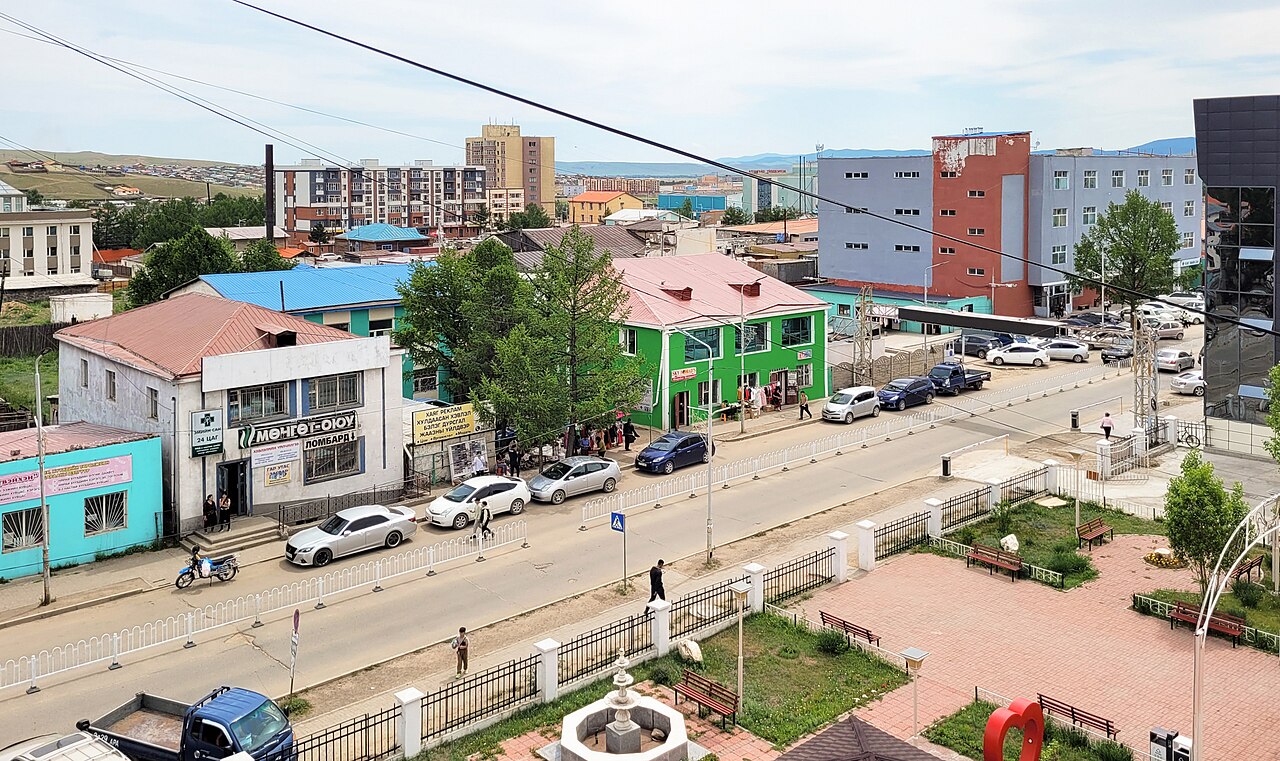
Street view of Tsetserleg, the centre of Arkhangai province in Mongolia, with low concrete buildings and apartment blocks. Bernard Gagnon, CC0, Wikimedia Commons.

Half a degree warmer at home
The strongest evidence that warmth affects attendance comes from homes, not schools. In 2001 and 2002, researchers in New Zealand worked with local organisations in seven low-income communities. Those organisations chose 1,350 uninsulated houses, and the researchers randomly assigned half to receive ceiling insulation, underfloor foil and draught-stopping in the first year. The other half got the same work a year later.
Bedrooms in insulated houses were only about half a degree warmer on average. They did spend 1.7 fewer hours a day below 10°C, and that seems to have mattered. In the insulated houses, the odds that a parent reported a child taking a day off school were roughly halved (odds ratio 0.49). The work cost about £700 a house, and a later analysis put the benefits at nearly twice the cost.
The trial was published in the BMJ and is the most rigorous of the three studies. Even so, the school absences were reported by parents rather than taken from school registers, and the setting was houses, not classrooms.
Reading this from a Syrian school
The conditions differ in ways that matter. Winters in most of Syria are much milder than in Mongolia, so the same insulation would save a different amount. Many Syrian classrooms are heated by a stove in each room rather than a central boiler, and none of these studies looked at that setup. A tighter room with a burning stove raises ventilation and fume questions that none of them answer. And a large share of Syrian schools have damage that comes before insulation: missing glass, broken doors, leaking roofs.
The Mongolian evaluation does point to some things that carry over. Who controls the heating matters. Moisture has to have somewhere to go. And a retrofit without a meter leaves everyone guessing about the saving. Maintenance tends to fall on the school itself. At a Rural Damascus school where UNICEF installed solar panels this year, the caretaker is the one who keeps them clean.
Several things are not known. Nobody appears to have published what it would cost to insulate a typical Syrian classroom roof, or how many litres of diesel a winter that would save. It is not clear whether parents and teachers, like those who repainted School No. 63, could take on smaller jobs such as sealing windows and doors, or what training it takes for a local builder to do that well. And no Syrian school has yet published a record of temperature and attendance through a winter.
Sources and further reading
- Humanitarian Action, "3.3 Education | Syria Humanitarian Needs and Response Plan 2026" (2026)
- Syria Direct, "Lack of services and staff shortages hit Suwayda countryside schools" (2 October 2017)
- Anadolu Agency, "Snow, floods hit Syria as winter storm forces class suspensions" (31 December 2025)
- OCHA, "Syrian Arab Republic: Developments in north-west Syria and Ras Al Ain – Tell Abiad, Situation Report No. 35" (January 2022)
- B. Braatz and C. Tingley for USAID, "Evaluation of the Ulaanbaatar School Buildings Thermo-technical Retrofitting Project: Final Report" (January 2013)
- Geres, "In Mongolia, a look back at the energy efficiency actions carried out in a school and a hospital in Arkhangai" (23 August 2022)
- Howden-Chapman et al., "Effect of insulating existing houses on health inequality: cluster randomised study in the community", BMJ (2007)
- He Kainga Oranga / Housing and Health Research Programme, "The Housing, Insulation and Health Study" (summary)
- UNICEF Syria, "Solar power brings brighter classrooms to students" (21 October 2026)