Can removing a road fix traffic? What Braess's paradox really says
Broadway is the one street in Manhattan that refuses the grid. It cuts diagonally across the avenues, and where it crosses them it makes tangled, many-legged intersections. New York City's transport department saw this as a problem hidden in plain sight: congestion and higher crash rates at those crossings than at other avenue intersections in Manhattan, and, in Times Square, too many people on too little pavement, walking in a roadway built for cars.
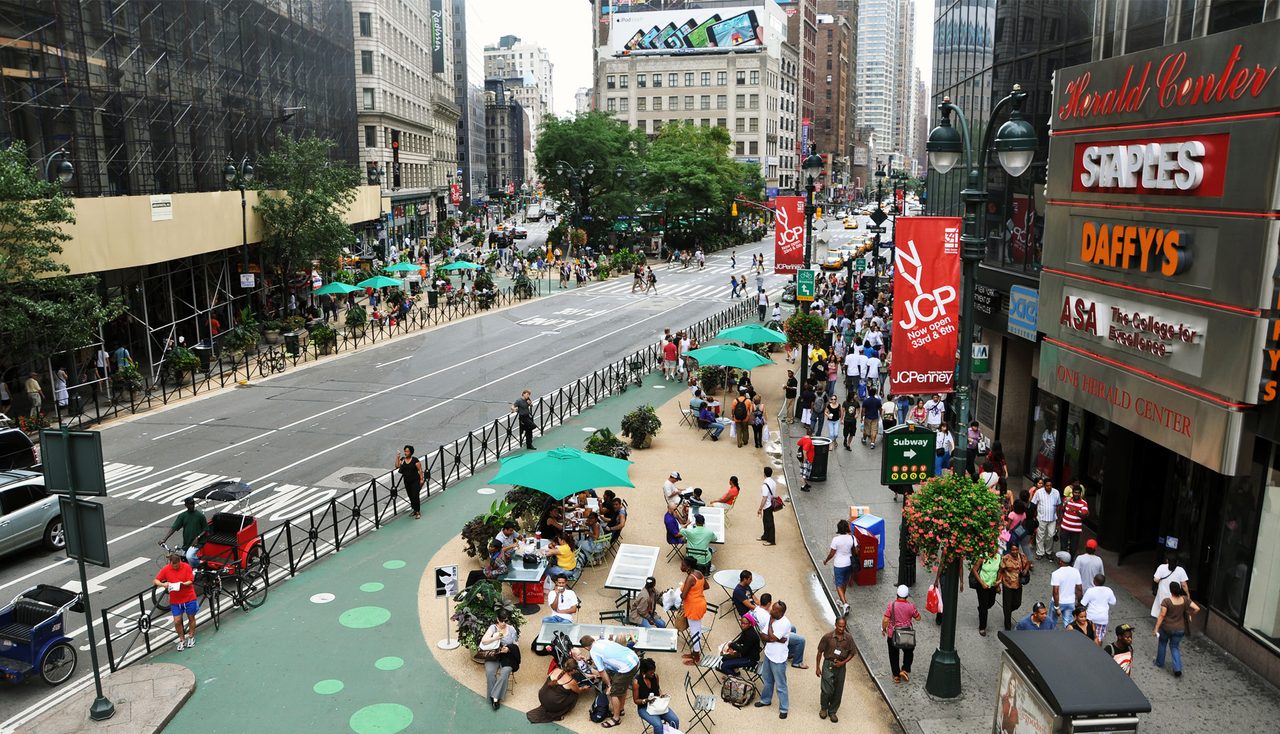
Herald Square in New York after Broadway was taken out of the traffic system: a pedestrian plaza with tables and umbrellas beside the remaining lanes. From the Data-Driven Design workshop presentation; original credit to be confirmed.
The experiment
In 2009 the city tried something that looked like the opposite of fixing traffic. Under a pilot called Green Light for Midtown, it took Broadway out of the traffic system at Times Square and Herald Square. It did not rebuild anything: the report calls the materials temporary, so the whole thing could be undone if the numbers turned against it. Without Broadway's leg at each crossing, the signals could give 7th Avenue 8% more green time and 6th Avenue 66% more.
Then the department measured, with taxi GPS data, 5,723 timed test drives in West Midtown, police injury records, pedestrian counts and surveys, and published the results in January 2010.
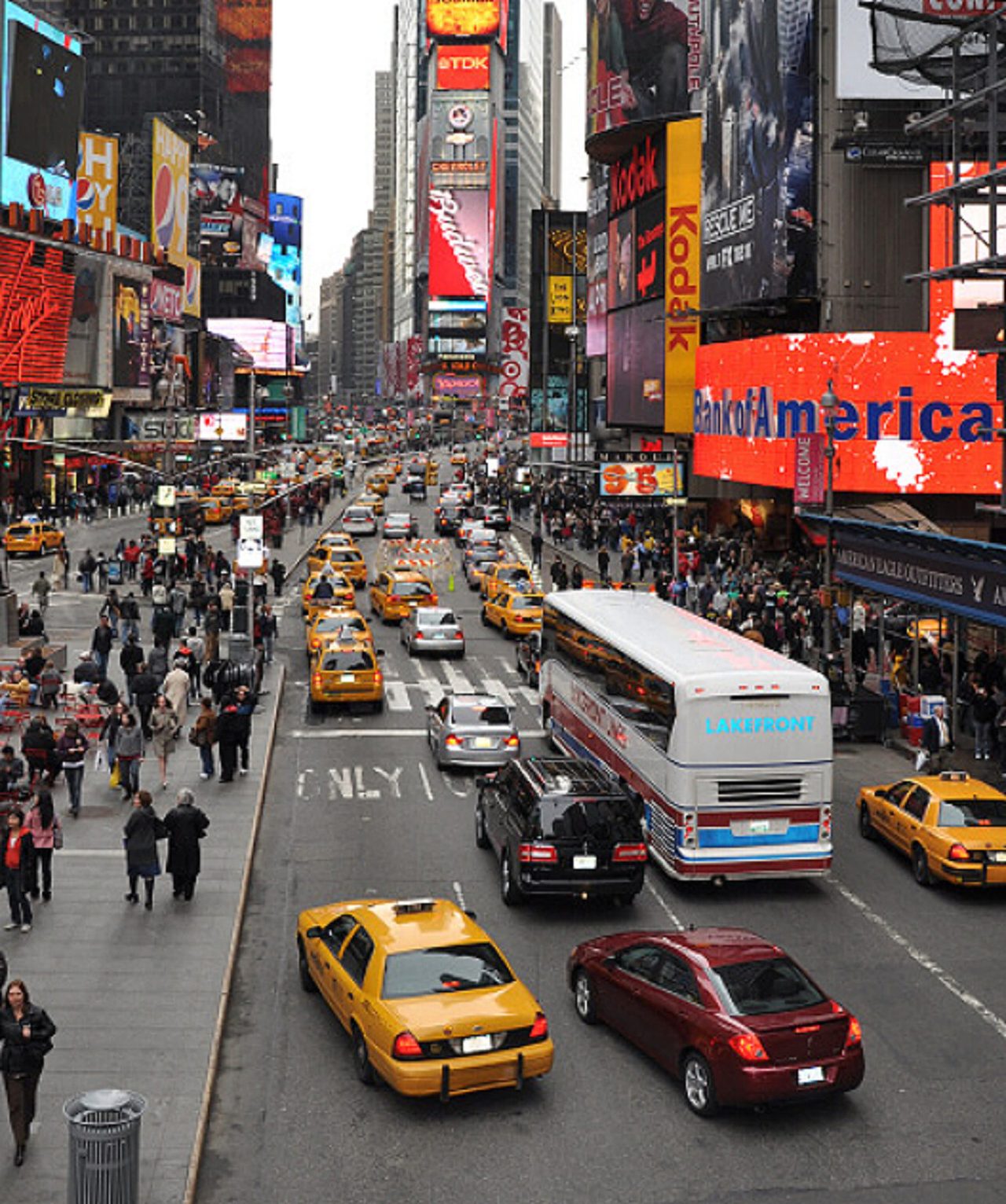
Times Square before the Green Light for Midtown pilot: taxis, cars and a bus filling the roadway, with the crowds squeezed onto the pavements. From the Data-Driven Design workshop presentation; original credit to be confirmed.
What the numbers said
Injuries fell. Injuries to people in vehicles were down 63% in the project area, and pedestrian injuries down 35%. The pedestrian figure is 37 injuries before and 24 after, from preliminary police data comparing June to November 2009 with the same months of the three years before. In Times Square it was 40% fewer, in Herald Square 53% fewer.
People left the road. 80% fewer pedestrians were walking in the roadway in Times Square, and the number walking along Broadway and 7th Avenue there rose 11%.
Traffic did not seize up, but it was not all better. Northbound taxi trips in West Midtown were 17% faster, against 8% faster in East Midtown, which was the comparison area. Southbound trips were 2% slower in the west and 3% faster in the east. Crosstown trips between 5th and 11th Avenues took 13% longer. The department itself wrote that results on the crosstown streets were highly variable.
DOT recommended making the changes permanent. Look at what the report is claiming: a safer, calmer centre, and traffic that moved about as well as before on the avenues, at some cost to the crosstown streets. It never says that closing the road made traffic faster everywhere.
Why does taking road away not clog the city? One answer is plain traffic engineering, and it is the one the report gives: with Broadway's leg gone from each crossing, the signals were simpler and the avenues got more green time. The other answer is a result from game theory that is famous, often misquoted, and worth understanding properly.
The mathematics: Braess's paradox
In 1968 the mathematician Dietrich Braess showed that adding a road to a network can make every journey slower. Here is the standard example.
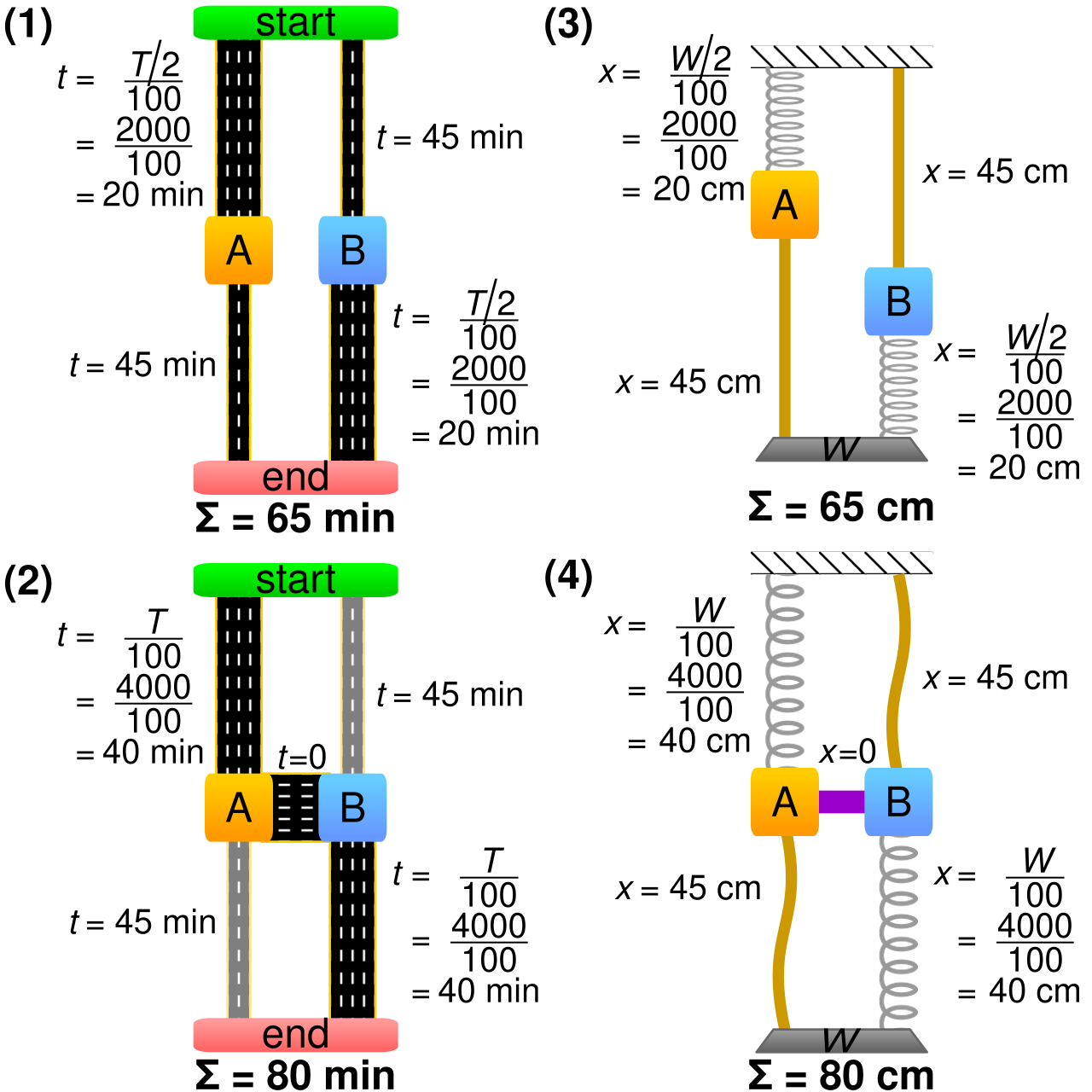
A different worked example of the same effect: with two separate routes the trip takes 65 minutes in total; adding a free link between the two midpoints raises it to 80 minutes. The effect is also shown with springs on the right. Cmglee, CC BY-SA 4.0, Wikimedia Commons.
Six drivers go from one point to another. Every driver picks the fastest route for themselves, and each trip takes 83 minutes. Add a new connecting link and every driver individually finds it worthwhile to switch. The result: each trip now takes 92 minutes. Closing the link gives back 9 minutes, a saving of 9.8%.
Nobody behaved badly. Each driver chose the best route given what the others were doing, and together they ended up worse off. Planners call the result a user equilibrium, and the road that causes the trouble a Braess link.
Two conditions keep the effect narrow:
It needs a band of demand. On this network the paradox appears only between roughly 2.6 and 8.9 vehicles. With fewer or more, the extra link does no harm.
It needs cross-connections. Simple series-parallel networks are immune.
How often does it happen in real cities?
Less often than headlines suggest. In the one systematic count on real street networks (Boston, London and New York), only 2.4% to 3.8% of links were Braess links, and that count tested single origin-destination pairs. In a calibrated model of Winnipeg, the best combination of 62 road closures saved 0.86% of total travel time. The set of harmful links also shifts with traffic volume, so a single model run proves nothing.
Other real closures tell the same mixed story. After the Paris riverbank closure in 2016, the regional evaluation found no "evaporation" of traffic a year on: traffic on the high quays rose and evening travel times there were 65% longer. Across 62 monitored schemes in the literature, the median net traffic loss was 10.6% of the traffic that used the treated road, but 11 of the 62 saw traffic rise.
Closing a road can reduce traffic, shift it elsewhere, or do both. Which happens depends on alternative routes, transit and how much people adjust their trips.
What to do with this
Treat Braess's paradox as a hypothesis generator, and start the way New York did, with a reversible trial and a before-and-after count:
Build the street network and an estimate of demand.
Solve the traffic equilibrium (every driver on their fastest route).
Remove each link in turn and re-solve.
Repeat at lower and higher demand, and report who loses as well as who gains.
With free tools (AequilibraE and OSMnx in Python) the full remove-every-link scan of a district takes minutes to hours. In our workshop tests, Sioux Falls (a standard test network) had no beneficial removal at all, and a London district showed no robust Braess link. Finding nothing is a valid result, and it is worth teaching.
Why it matters for cities rebuilding their networks: it is cheaper to test an intervention in a model, or in a reversible trial, than to build it and find out.